
Agent memory
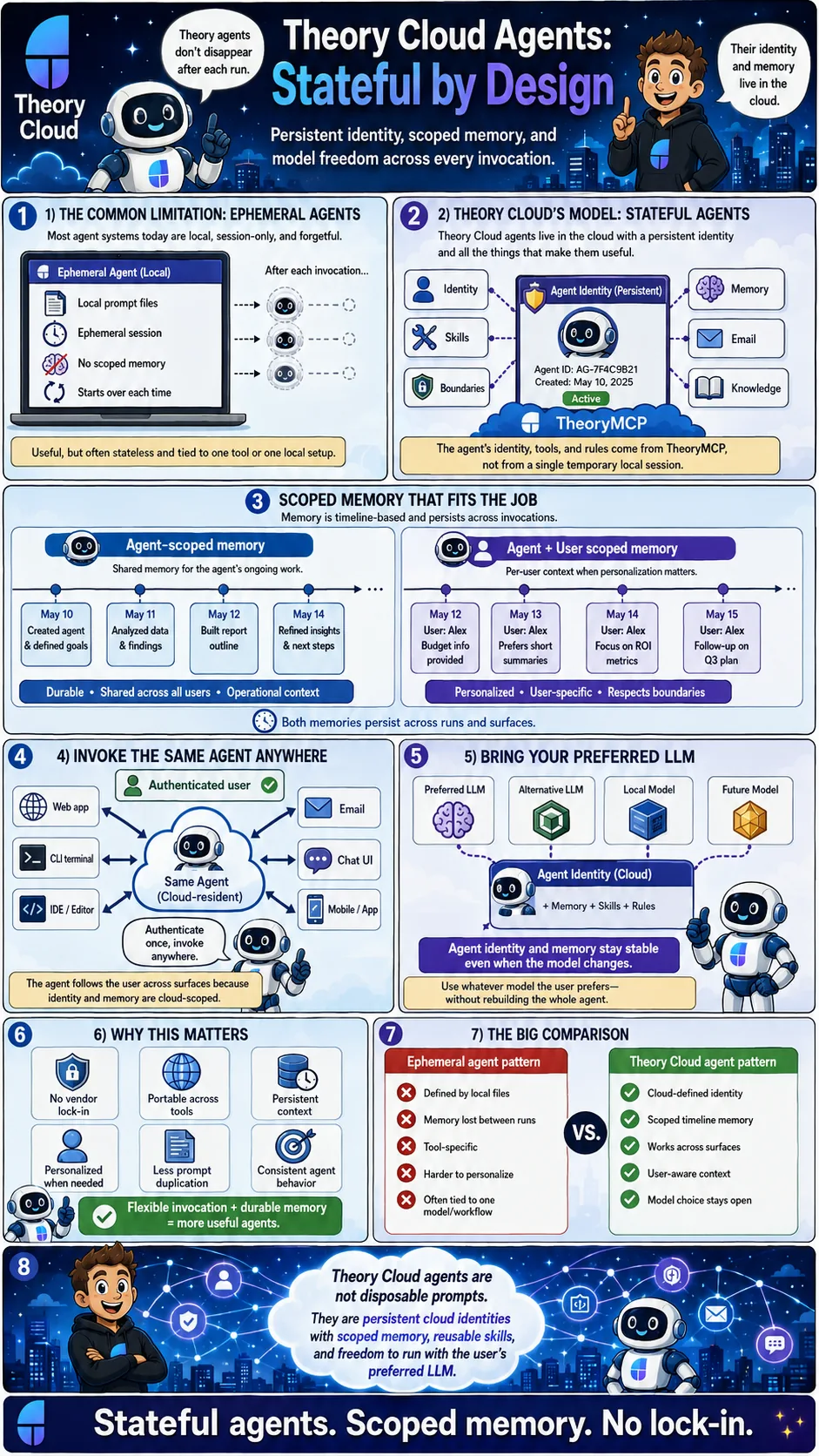
Memory is the most important consumer-facing behavior of an agent endpoint. It’s what turns a series of disconnected calls into a relationship with a durable agent.
The model
TheoryMCP memory is:
- append-only — entries are written into a ledger, not rewritten in place;
- deterministic — the same inputs behave the same way;
- agent-routed — the agent route selects which ledger family is used;
- subject-scoped — the authenticated subject selects whose visible memory is returned.
The practical outcome:
Two different users can use the same agent endpoint without ever sharing memory with each other. And the same user gets continuity across sessions — even if they switch the underlying model.
The tools
| Tool | Purpose |
|---|---|
memory_append |
add a new entry for the authenticated user (server stamps the author) |
memory_recent |
fetch the most recent visible entries for the current user on this route |
memory_get |
fetch one entry by memory_entry_id, if it belongs to the current user |
A memory_append returns a server-generated memory_entry_id. You never send author_subject_id;
the server derives it from your token.
// memory_append input
{ "content": "Customer prefers architecture diagrams before code examples.", "entry_type": "note" }

// representative result
{ "created": true, "memory_entry_id": "mem-abc123…", "entry_type": "note", "created_at": "2026-04-20T13:00:00Z" }
Copyable prompts
Write something worth remembering:
On the apptheory agent in theorycloud, append a memory entry: "<the durable fact or preference>"
with entry_type "note". Confirm the memory_entry_id you got back.
Resume where you left off:
Connect to the apptheory agent endpoint and call memory_recent (limit 10). Summarize what you
already know about me / this project from those entries before we continue.
Idempotent write (safe to retry):
Append this memory once, even if the step runs twice: content "<fact>", entry_type "note",
idempotency_key "<stable-key-for-this-step>".
Make retries safe
Pass an idempotency_key when a write might be retried (a re-run step, a flaky connection). The
ledger collapses repeats of the same key into one entry, so retries don’t duplicate memory.
What memory is not
- It is not a shared transcript. There’s no common chat log between users on the same agent; each subject’s memory stays private.
- It is not editable in place. The normal flow appends; you don’t rewrite history.
- It does not cross routes. Memory on one agent endpoint is that agent’s ledger family — a different agent is a different memory.
Good habits
- Recall before you act. Start agent sessions with
memory_recentso the agent uses what it already knows. - Append the durable, not the disposable. Preferences, decisions, constraints — not this turn’s scratch work.
- Let the server own identity. Don’t send subject ids; the token is the identity.
- Mind the scope. Writing memory needs the
memory.appendscope. The agent route’s default scope set covers it; if you pin scopes by hand, includememory.appendormemory_appendfails closed.
Next: an agent’s optional mailbox & email, or pull the agent’s interface into your workspace with Integrate an agent.